




Natalia Quintero joined Every earlier this year as a a consulting partner to build our consulting practice, and I’m excited to announce she’s now our head of consulting. Before Every, she led Silicon Valley Bank’s Latin America tech portfolio and was the senior vice president of technology and innovation at the Partnership for New York City. Since joining us, she’s built a seven-figure business leading AI training and adoption at some of the largest and most advanced companies in the world—and in her first piece for Every, she shares the patterns she’s seen.—Dan Shipper
Was this newsletter forwarded to you? Sign up to get it in your inbox.
Earlier this year, I joined Every as the head of consulting. Since then, I have had conversations with more than 100 startups, hedge funds managing billions, creative agencies, private equity firms, media companies about their AI implementation challenges. I keep hearing the same thing: We have the tools. We have a few power users. We don’t know where to go from here.
It’s the same challenge I faced when I worked with the New York City subway in a previous role, creating a map that finally showed commuters trains and delays in real time. The technology exists. The information exists. But until you translate it into something people can use in their daily workflows, until you close the gap between what’s possible and what’s practical, nothing meaningful happens.
That’s why we see headlines like the MIT report that went viral earlier this year, claiming that 95 percent of generative AI pilots at companies fail. But this is not because executives have a technology problem. They have a clarity problem. They lack a view on what they’re trying to achieve, let alone how AI might help them get there.
The good news is that you’re not behind, even if it feels that way. It’s still so early that most people haven’t moved past using AI as a slightly smarter Google. The companies figuring this out aren’t always more technically sophisticated, but they are more aligned on a north star and committed to using all resources to get there.
Here’s what I’ve learned about the state of generative AI adoption—tools like ChatGPT, Gemini, and Perplexity—within companies, and what separates the companies where AI is making an impact from the ones where enterprise licenses gather dust.
Executing an AI-first strategy with Box
Sixty percent of enterprises expect AI transformation within two years, and Box’s “Executing AI-First” series is the step-by-step playbook for empowering teams to thrive in the era of AI. In this series, you’ll learn:
- How Box approached becoming AI-first through its value realization strategy
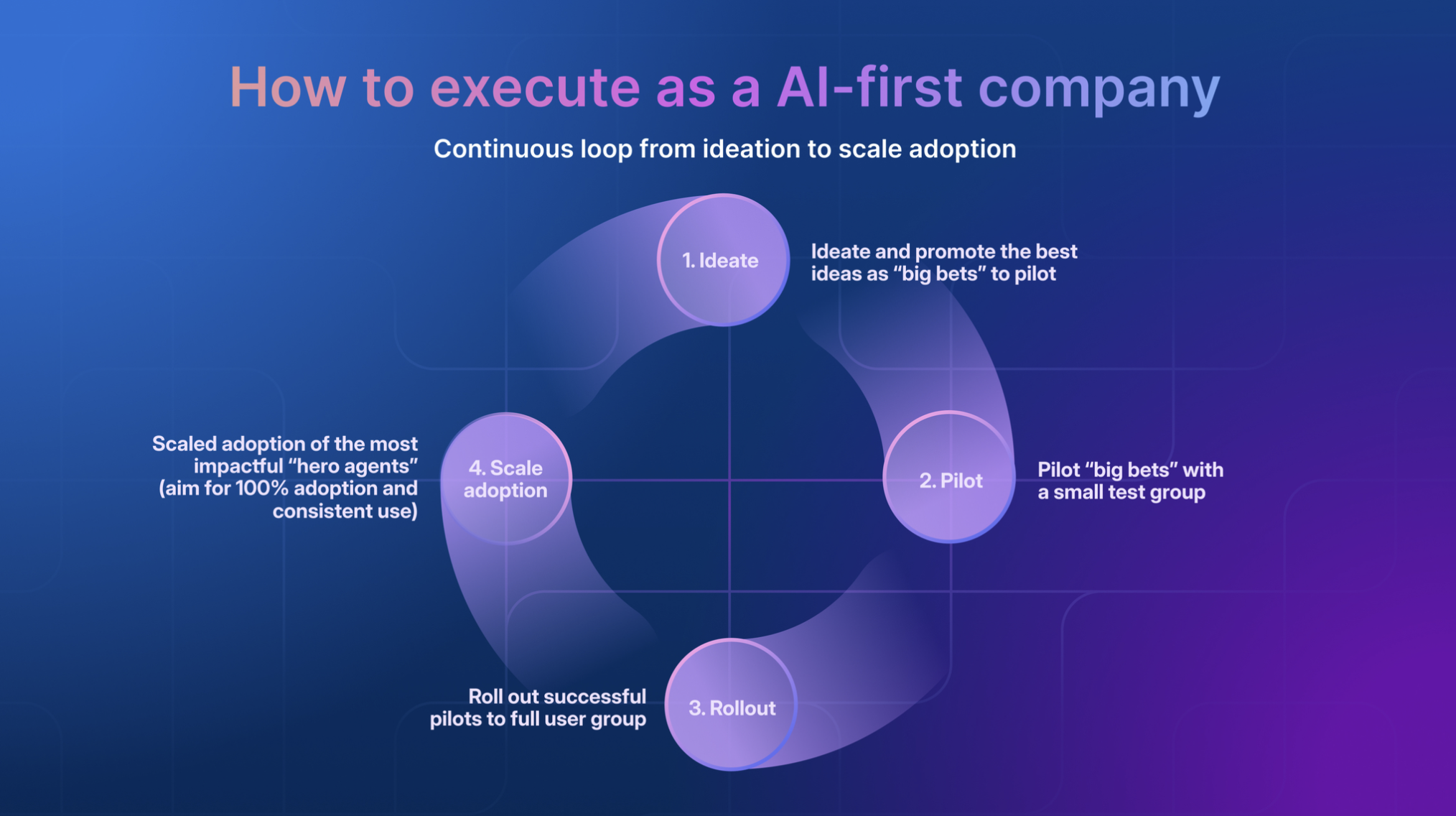
- How to deploy agents with an ideate > pilot > rollout > scale plan
- How to be an AI manager
- How to measure what matters by tracking AI agent impact
Read the first article in Box’s series and follow along for actionable insights and downloadable templates.
Most people are still getting started
I’m still surprised that AI use is incredibly elementary. I don’t mean “people haven’t tried the latest model”-elementary. I mean a lack of basic prompting skills. No knowledge that different models exist, and you can choose among them. No understanding of when to use AI like Google versus when to build something that automates a whole workflow, like n8n.
Because we use AI so differently in our work at Every, the gap continues to catch me off guard. When I dig into why many people are not consistently using AI at work or haven’t found more sophisticated use cases, I find three personas:
The skeptics. They are uncomfortable with new technology and doubt that it will work at all. At many companies, initial engagement with AI tools is high, but usage drops off quickly. The excitement fades when reality sets in: This requires learning a new skill, and (like with any skill) it’s a time-consuming, ongoing effort.
The overwhelmed. They have the tools. They might even want to use them. But they’re drowning in existing work and have no bandwidth to experiment or even be excited about the idea of experimentation. Or as one person told me: “If you talk to me about prompt engineering, I’m going to cry.”
The tool-jumpers. This is analysis paralysis disguised as progress. They’re evaluating 30 different tools, switching platforms, and chasing the latest release, but never mastering any of them. One firm told me they “struggled to get documents into ChatGPT,” so teams switched to Perplexity. The tool changed, but the adoption problem was never solved.
Aside from the interpersonal dynamics that hold AI adoption back, there is also the issue that AI doesn’t spread like other software.
Think about Asana. If one person decides to organize their team’s tasks there, everyone benefits automatically because the work is more organized, and someone on the team has taken responsibility for that organization. You don’t need to learn the tool to get value from your colleague using it.
AI doesn’t work that way. If you develop workflows around how you work, that value doesn’t automatically translate to the rest of the company. Your prompts, your GPTs, your automations—they’re built around your context, your processes, and your way of thinking. They don’t transfer. This is compounded by the fact that employees at many big companies can’t always access generative AI tools for security or compliance reasons. They may be stuck using Copilot because their employer uses the Microsoft software suite, and can only use Claude or ChatGPT outside of work.
This creates a persona we see constantly: the lonely power user. Someone figures out how AI can transform their work. They’re getting real value from it. And they’re completely siloed, unable to spread what they’ve learned because AI adoption requires everyone to develop basic fluency, or their team is dragging their feet on allowing the use of these tools.
The recruiting firm that figured AI adoption out
So if the technology works but adoption doesn’t spread, what does?
When we started working with a 70-person recruiting firm, the company was overwhelmed with tedious administrative work. They needed help but had no bandwidth to experiment, and were resistant to the idea of having to learn one more thing alongside all the other work they needed to do.
So instead of company-wide training, we trained 10 people. These AI champions, a mix of young employees and team leaders, were nominated by leaders in the organization. This group had four characteristics: a willingness to learn, permission to build, room to fail, and eagerness to share with colleagues.
One of those selected created a GPT that automatically generated scheduling availability across candidates, recruiters, and clients. This work—which she described as “tedious and painful and administrative…yet critical”—previously took hours. It required coordinating across three calendars, sending multiple emails, and playing phone tag.
The GPT saved each recruiter between two to 10 hours per scheduling task, which added up to dozens of hours saved each week, given how many times they were scheduling calls.
But what mattered more than the time savings for long-term adoption was the fact that this tool had been created by their peer. Not a consultant. Not an engineer. Not someone “technical” or “at the forefront of AI.” The tool came from someone who wasn’t supposed to be good at this, which made it feel accessible.
Suddenly, 30 people didn’t need three tabs open plus their calendar to coordinate schedules. And those 30 people became curious about what else they could automate.
This is the pattern I see in every successful AI adoption: It doesn’t start with company-wide rollouts. It starts with a few champions who have permission from leadership to experiment, building something useful that their colleagues want to use.
It’s about having clarity on what you want to achieve
That recruiter knew exactly what she was trying to achieve, how she wanted to achieve it, and what success looked like.
Most people don’t have clarity on what their goal is, let alone the specific steps needed to achieve it. They open ChatGPT, type something vague like “help me with this,” get a mediocre response, and close the tab.
This is the insight most people miss: The hard part of using AI isn’t using AI. It’s sitting down with yourself and thinking: What am I trying to achieve, and how do I want to go about doing that with AI?
Think of AI like training a smart intern. To train someone junior well, you need to be prescriptive: How do you write an email? What tone do you use with clients? What does excellent work look like? What are the steps? What are the pitfalls? The more specific your guidelines, the more you set them up for success.
AI is the same. If you can document your goals, your process, and your definition of success—if you can explain it clearly enough to train a junior employee—you can use AI effectively.
This era will be remembered as the era of standard operating procedures, in other words, laying out in plain English exactly how you do your work. You can only automate something if you have a clear picture of what success looks like and what needs to be done to get there. Without that clarity, you’re throwing prompts at a wall.
What successful companies do differently
The companies getting AI adoption right share specific characteristics. They’re not doing anything wildly sophisticated—but they are doing things intentionally.
Leadership uses it personally. At Walleye, a multi-strategy hedge fund with $10 billion under management (and an Every client), the CEO understands AI’s impact because he uses it constantly himself. He knows both what it can do and its limits, and that understanding comes through in every conversation he has across the organization. It’s infectious. When leadership models curiosity instead of mandating compliance, it becomes permission for everyone else to experiment.
They invest in centralized testing. Some firms have a small team responsible for evaluating new technology. They go through the chaos of testing 30 different AI tools so nobody else has to. They identify what’s valuable, then share best practices with the entire organization, saving everyone else from tool-jumping and analysis paralysis.
They start with champions, not rollouts. Three to five people from different levels in the organization who have bandwidth, permission to experiment, and freedom to fail build solutions their peers can use—like the recruiter with the scheduling GPT. The adoption spreads organically because it’s peer-to-peer, not a top-down mandate.
They already have a documentation culture. This is where financial institutions and engineering teams have a natural advantage. They’re used to writing things down, defining processes, and documenting decisions. That muscle makes AI adoption significantly easier because to automate workflows, you need to be able to write them down clearly. If your company doesn’t have that culture yet, building it is the first step—not buying more tools.
You are not behind
If there’s one thing I want you to take away from this, you are not behind.
Large companies are still getting their bearings. Most people haven’t had a real opportunity to develop AI fluency. The gap between the hype and the reality is enormous. 2025 was the year of AI experimentation, but experimentation is not failure. It takes time to go from ideation to value, so I’m betting that 2026 will be the year of AI adoption.
But understand that this is as much a cultural challenge as a technological one. You’re not implementing a tool. You’re helping people rethink how they work. Here’s where to start:
Take an hour to document your team or a team’s workflows ranked by how valuable each task is, how many hours it takes to complete, and if it’s automatable by AI. Better yet, dictate it. This becomes the outline that you can use to feed into AI and take the first step towards becoming an AI-native company.
You don’t need to stay current with every model release. You don’t need to become technical. You need to get clear on what you’re trying to achieve and how you want to go about it.
That clarity is what unlocks everything else.
And what does success look like? The recruiting firm we work with had a goal of spending more time with each candidate they placed. This is AI at its best, automating tedious, administrative work, and enabling people to spend more quality time with each other in support of joint goals.
If you’re looking for a team that will go beyond strategy and train your team to use AI, reach out to us at every.to/consulting.
Thanks to Katie Parrott for editorial support.
Natalia Quintero is the head of consulting at Every. You can follow her on LinkedIn.
To read more essays like this, subscribe to Every, and follow us on X at @every and on LinkedIn.
We build AI tools for readers like you. Write brilliantly with Spiral. Organize files automatically with Sparkle. Deliver yourself from email with Cora. Dictate effortlessly with Monologue.
Get paid for sharing Every with your friends. Join our referral program.
For sponsorship opportunities, reach out to sponsorships@every.to.
The Only Subscription
You Need to
Stay at the
Edge of AI
The essential toolkit for those shaping the future

"This might be the best value you
can get from an AI subscription."
- Jay S.
 Every Content
 AI&I Podcast
 Monologue
 Cora
Cora
 Sparkle
 Spiral
Join 100,000+ leaders, builders, and innovators

Email address

Already have an account? Sign in
What is included in a subscription?
Daily insights from AI pioneers + early access to powerful AI tools


 Front-row access to the future of AI
 In-depth reviews of new models on release day
Playbooks and guides for putting AI to work
Prompts and use cases for builders
In-depth reviews of new models on release day
Playbooks and guides for putting AI to work
Prompts and use cases for builders
In-depth reviews of new models on release day
Playbooks and guides for putting AI to work
Prompts and use cases for builders
In-depth reviews of new models on release day
Playbooks and guides for putting AI to work
Prompts and use cases for builders
 Bundle of AI software




 Reviews of new AI models on release day
Comments
Don't have an account? Sign up!
As I'm spinning up my own consulting company to help introduce AI to small businesses in small-town America, I found solid advice in Natalia's idea of working with a small, internal "tiger team" (rather than the whole org at once). Overall, truly a clarifying article, many thanks!
"This is where financial institutions and engineering teams have a natural advantage. They’re used to writing things down, defining processes, and documenting decisions." Great point, well said!
Amazing!
Happy to share this wonderful piece.
'You can only automate what you can clearly define--' So basic, so true.
"You need to get clear on what you’re trying to achieve and how you want to go about it."
Truly great artlcle for this time.
A lovely article and right on the beam. Folks, take a moment and look into https://thecynefin.co/. Learn about AI happenings here and red at Cynefin for how to review and implement if applicable.