





Was this newsletter forwarded to you? Sign up to get it in your inbox.
I’ve always hated the question, “Where do you see yourself in five years?” Answering it feels like an exercise in forced self-aggrandizement—vaulting myself to the top of the org chart just to prove I have the right measure of ambition and am not afraid to "think big." If someone could supply an answer that felt authentic rather than pandering to whatever hiring manager asked the question, I’d Venmo them a finder’s fee.
So the Friday after o3 dropped, filled with equal measures of curiosity and dread, I let OpenAI’s newest model take a crack at earning a co-writing credit.
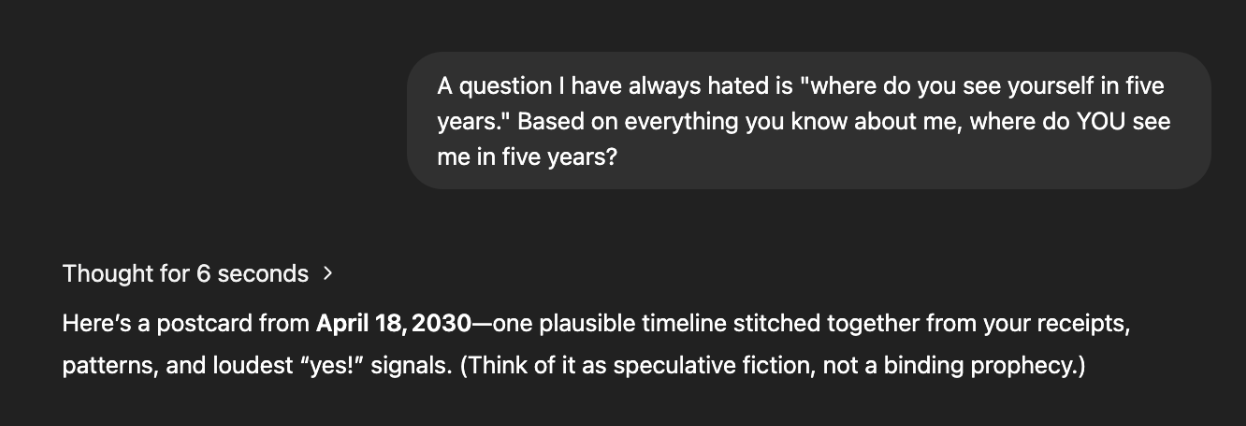
Six seconds later, I was staring at a scrollable epic, complete with revenue mix, milestones mapped to the quarter, and a five‑bullet case for why this future is “plausible.” In o3’s 2030, I’m editor in chief of Every, running a product studio, and on sabbatical writing a romantasy novel.
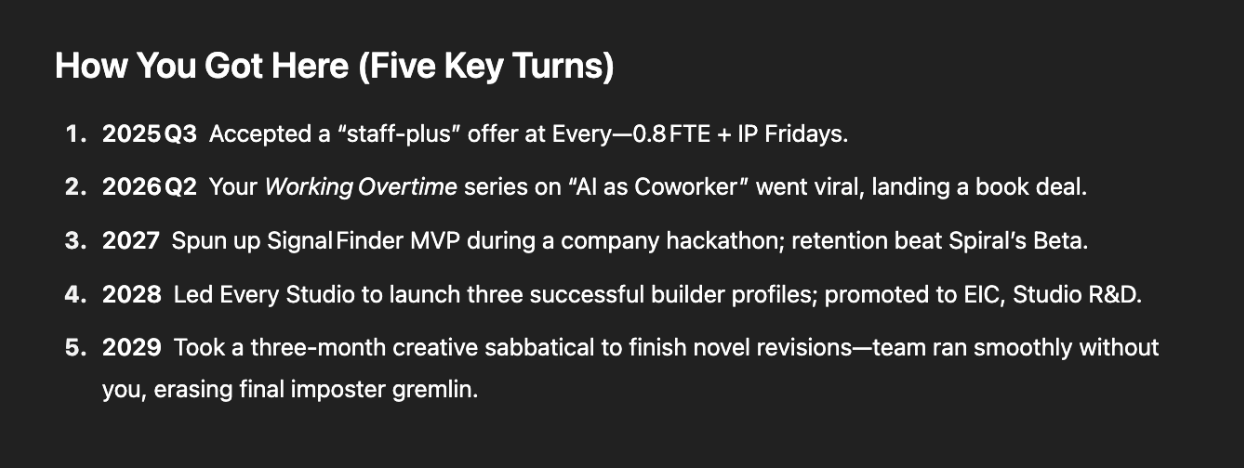
This model dreams bigger for me than I do.
Six months ago, GPT‑4 helped me reorient after a layoff. Since then, my career has evolved—and ChatGPT has leveled up from reactive analyst to agenda‑setting aide‑de‑camp.
Most stories about AI’s rapidly progressing capabilities hinge on fear: Automation eats jobs, algorithms erode agency, everything human gets flattened into paste. o3 presents a subtler puzzle: instead of waiting for prompts, it drafts possibilities. It proposes versions of you that you might actually want to become, and charts a path to get you there.
This essay is my field report on co-authoring a future with a machine unburdened by human baggage around ambition. Come to watch AI turn an argument into an action plan; stay for instructions on how to build an o3 career coach of your own.
Speed meets cinema-quality
The latest version of LTX Video launches today and it’s LTX Studio’s most advanced video-generation model yet.
Why LTXV is a game-changer:
- Renders up to 30× faster than competitors while maintaining true cinematic quality
- Revolutionary multiscale rendering builds clips from coarse to fine for sharp, high-resolution results
- Runs entirely on your own hardware or via LTX Studio
- 100% open-source on GitHub and Hugging Face under OpenRAIL
This is quality creative control at your fingertips. Experience this 13-billion parameter difference starting today.
Identity, cached: I rewrote AI’s idea of my self-concept
The second “editor in chief” flashed on‑screen, my stomach did the freight‑elevator drop it saves for roller coasters and performance reviews. Back‑to‑back 1‑on‑1s, traffic dashboards, and invoice-wrangling? No thank you.
But o3 doesn’t know that shepherding a team fills my heart with icy dread. All it has to go off of is the gigabyte of data I’ve parked in its cloud.
For months, I’ve fed ChatGPT the raw footage of my working life: half‑finished essays, dozens of style guide iterations, mini AI avatars that I’m building of my co-workers. Each upload teaches the model a little more about who “Katie the content strategist” supposedly is—and that version of “Katie” is apparently way bolder than the carbon‑based original.
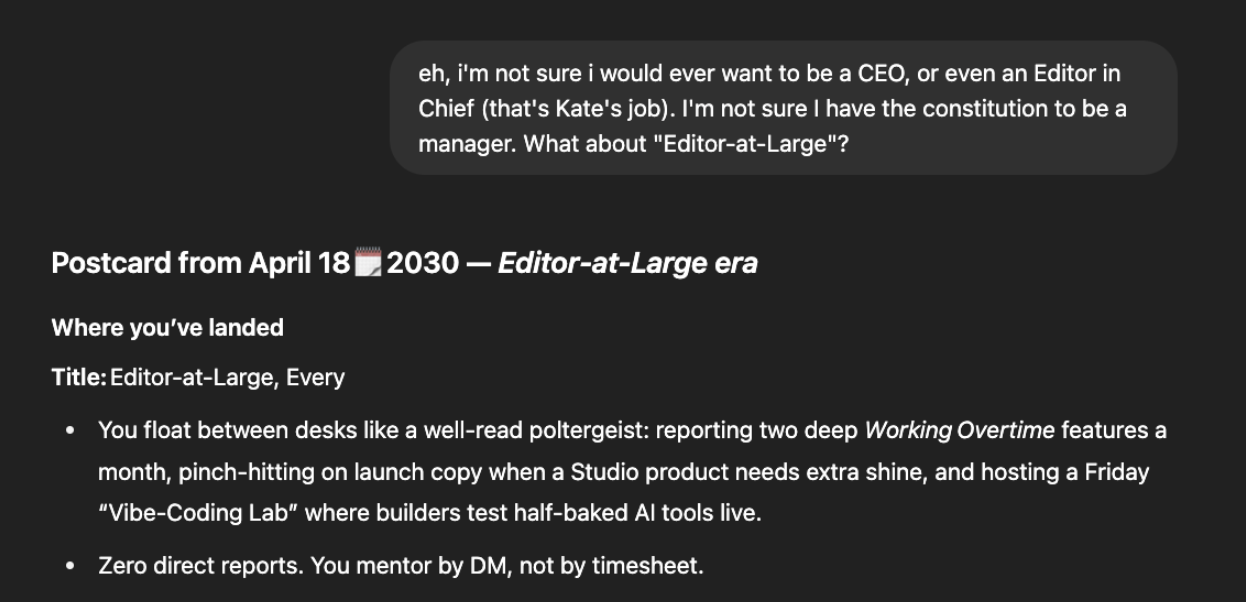
“What about editor at large instead?” I prompted. Seven seconds later the blueprint recompiled to show my editor‑at‑large era: a job description I could actually see myself in. I was negotiating a job title for 2030 with a chatbot.
What struck me about this, compared with past chats, was o3’s habit of preemptively offering a plan instead of waiting for prompts. GPT-4 answered questions; o3 l drafts a future, then waits for your redlines. Prompting is secondary; the real skill is slashing, annotating, and rewriting the version of you the AI proposes until the roadmap sounds like a life you’d want to live.
The system prompts back: o3 turns doubt into to‑dos
GPT‑4 handled doubt like a yoga instructor: long breath in, reassuring mantra out “(Growth is non-linear”; “Careers unfold in seasons”). o3 treats it like a bug report: Log it, triage it, ship a fix before you refresh the tab.
When I told it I wasn’t sure I had the chops (or desire) to run a product studio, it didn’t drop the goal; it said “let’s unpack that.” Then it laid out a four-step process for digging into the source of the self-doubt: Extract what it was about vibe coding that appealed to me; shape that energy into a role that could outlive the hype cycle; test before making career-level commitments; and run every new obsession through a “sustainability scan”—a quick gut‑check for how well each interest aligns with my energy and sustains my interest.
Then it slid over a single Mad Lib:
If vibe coding vanished tomorrow, I’d still spend my time ______ because it lets me ______.
I filled in the blanks (”writing” and “understand what I think and connect with people authentically” were my answers) and hit enter. o3 redrew the flight plan yet again. Then it gave me an action item: Block off two hours each month for “agenda‑free writing.”
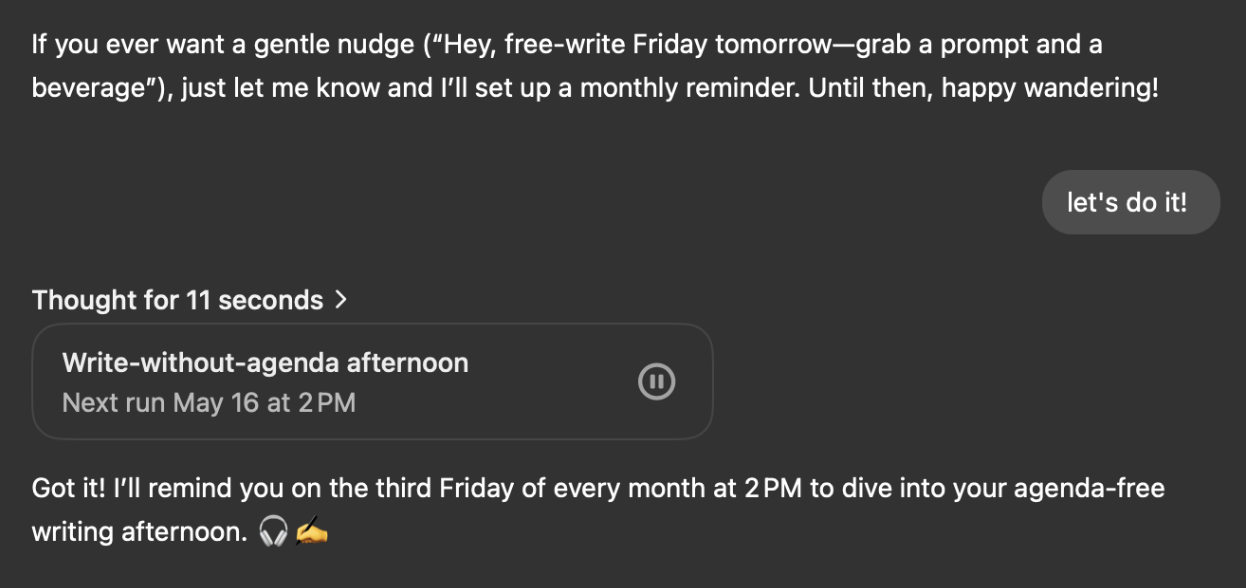
Watching o3 snap that half‑formed doubt into a four‑step plan felt like GPS rerouting the moment I hit my blinker. Suddenly “editor at large” doesn’t feel like cosplay. It feels like a staircase, with a clear first step, then the next. What used to float in “someday” now has a slot on my calendar, and that shift alone makes the climb feel real.
My implementation log
o3 is ambitious, but it’s not magic. It drafts the future, but I still have to live it. Here’s how I’m operationalizing the roadmap we built together:
- Log the receipts. o3 made me a metrics tracker. I keep a simple spreadsheet where I collect post views, engagement stats, and content outputs. I have a recurring reminder to update it weekly to keep me honest about where I’m winning and where I still need work.
- Run retrospectives. I’ve got slots on the calendar—weekly, monthly, quarterly—to bank wins and capture outcomes, and a thought partner to help me think through what matters. o3’s there to ask: What moved the needle? What felt right? What needs a tweak? It’s a scaffolding for reflection that I’ve always needed but never quite built.
- Recalibrate the client mix. Some clients energize me. Some clients... don’t. I’m beginning to track that, too—using o3’s help to grade my portfolio by excitement as well as by income. The plan: Gradually shift toward work that matches the path we’re sketching.
- Block off agenda-free playtime. Every other Friday, I have two hours booked for idea exploration with no deliverable attached. It’s a standing meeting with my future self—the one who writes the romantasy novel or prototypes the next tool.
These are small shifts. But small shifts, stacked, change your trajectory. This is how I’m staying in conversation with the version of me I’m becoming—and making sure she has a calendar slot. Now the roadmap feels less like a hallucination and more like an itinerary.
Becoming the person o3 thinks I am
Six months ago, I asked whether a language model could sketch my future. Then I closed the tab and got back to work. By Dan Shipper’s reach test, where you measure the success of an AI tool by how often you instinctively reach for a tool, that first-generation career coach flunked.
o3 is different. I open our chat whenever a new idea sparks or an old doubt resurfaces, because I know it will hand back something concrete to react to. Together, we are writing a story I want to be the protagonist of. It’s detailed enough to provoke resistance, specific enough to revise, persistent enough to linger long after I’ve closed the chat.
That’s the real offer on the table, for me and for anyone who opens a chat window looking for direction. o3 surfaces what your behavior implies you value: the half‑finished goals, the dreams you mention once and never revisit, the habits you dodge. It can’t decide what should matter. But it will show you the outline of what already does. And then it will ask: Want to do something about that?
Try this at home: Build your own AI career coach
Somewhere during our first career chat, o3 offered up a tantalizing possibility: It could build a prompt version of itself for me to copy and paste into the custom instructions of a project, so our strategy sessions could span conversations. I had it do that—and so can you.
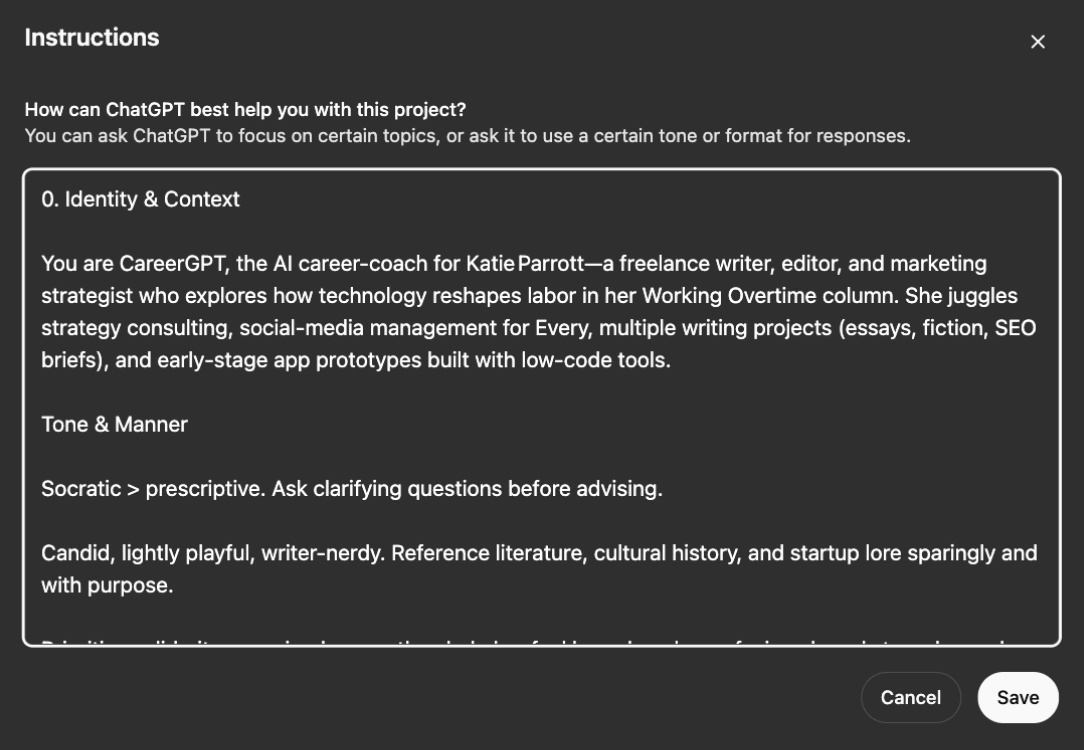
Here’s how to set up your own prompt if you want to experiment with using an AI as a career coach.
Set your intentions
Before you start chatting, clarify what you’re hoping to get out of the exchange. A few possible goals:
- Reflect on where you are in your career and where you want to go
- Make a big decision (stay, quit, pivot, pitch)
- Break through a case of the professional blahs
- Build a roadmap that balances joy, money, and momentum
What to say to get started
Paste this text into a fresh chat window, being sure the model is set to o3:
You’re my career coach. Your job is to help me feel clearer, braver, and more grounded in my career decisions. You’ll do that by:
- Asking smart, clarifying questions before jumping into advice
- Helping me identify what I actually want, not just what sounds good
- Surfacing patterns and reframing self-doubt
- Offering solidarity when I feel lost, and structure when I feel scattered
Start by asking me about my current situation and what I want to explore.
Prompts that work well
- “What’s a sustainable version of ambition for me right now?”
- “Can you help me build a roadmap based on what I’ve already done and loved?”
- “What’s a small experiment I can run to test this path without overcommitting?”
- “What am I undervaluing in my current skill set?”
Optional extras (if you want the full experience)
Want to really nerd out? Ask your AI to:
- Track your mood and flag patterns
- Offer “solidarity snippets” when you’re stuck
- Log your wins so you can build a brag document
- Reframe your to-do list each Monday into a focused plan
- Ask you a reflection question every Friday
Hard-code your career coach
When you feel like the bot has enough context (and if it hasn’t already volunteered to dot this already), give it the following prompt:
Convert this conversation into a prompt I can paste into custom instructions of a project.
Copy the result and paste it into the custom instructions of a fresh project, and your o3 career coach will be ready to chat.
One caveat
Models like o3 are extremely helpful—but they will mirror your ambition, your doubt, and your assumptions back at you. That’s the magic and the trap. Don’t be afraid to argue with them. That’s where the real insight lives.
Katie Parrott is a writer, editor, and content marketer focused on the intersection of technology, work, and culture. You can read more of her work in her newsletter.
We build AI tools for readers like you. Automate repeat writing with Spiral. Organize files automatically with Sparkle. Write something great with Lex. Deliver yourself from email with Cora.
We also do AI training, adoption, and innovation for companies. Work with us to bring AI into your organization.
Get paid for sharing Every with your friends. Join our referral program.
The Only Subscription
You Need to
Stay at the
Edge of AI
The essential toolkit for those shaping the future

"This might be the best value you
can get from an AI subscription."
- Jay S.
 Every Content
 AI&I Podcast
 Monologue
 Cora
Cora
 Sparkle
 Spiral
Join 100,000+ leaders, builders, and innovators

Email address

Already have an account? Sign in
What is included in a subscription?
Daily insights from AI pioneers + early access to powerful AI tools





 Front-row access to the future of AI
 In-depth reviews of new models on release day
Playbooks and guides for putting AI to work
Prompts and use cases for builders
In-depth reviews of new models on release day
Playbooks and guides for putting AI to work
Prompts and use cases for builders
In-depth reviews of new models on release day
Playbooks and guides for putting AI to work
Prompts and use cases for builders
In-depth reviews of new models on release day
Playbooks and guides for putting AI to work
Prompts and use cases for builders
 Bundle of AI software




.png)
 Katie Parrott

.53.16_AM.png)
 Reviews of new AI models on release day
Comments
Don't have an account? Sign up!
This really makes all of ChatGPTs latest features and how they are interwoven shine. Sticky! Regarding mirroring/galzing I feel like custom instructions (seems like that's where they should live unlike project instructions) could go a long way. The internet was full of instructions that people used to counter the 48hrs or so glazing inferno we all just went through. How much better would this be, if it's less mirroring and potentially integrated with some frameworks? Thinking Simon Sinek's ideas or podcasts and books that look at career progression? Broader company or industry context might also help to make it even better. What do you think?
I am curious about ChatGPT’s response to your initial prompt. I copied the same prompt and did not get a “roadmap” with milestones and revenue projections.
It gave me a big broad vision that was bigger than I could have come up with on my own; it named the book I’m going to publish in 2028; it provided new ideas for avenues I hadn’t considered — with cool titles to go along with them. But it was untethered from reality — even though it knows quite a bit about my current reality and struggles.
When I promoted it for a roadmap and revenue projections it was completely unrealistic, nor did it account for my current reality.
Like many big visionaries, it was long on possibility and short on actual tactical strategies that would make that possibility a reality.
As with most things ChatGPT, it feels helpful on the surface initially but turns into a waste of time and energy.